
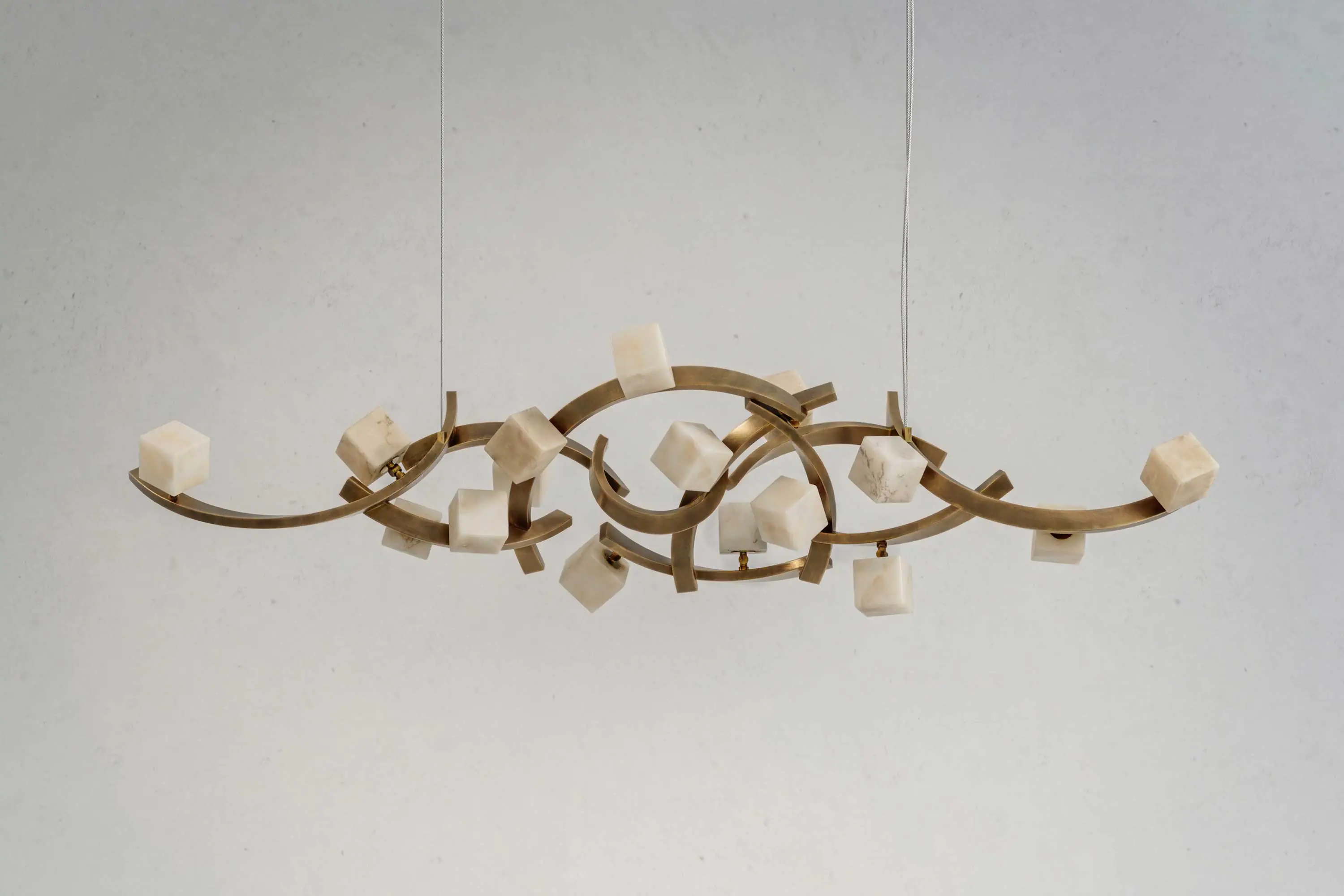
Cirro chandelier, interlocking bronze arcs with onyx cubes

Design Narrative

Cirro

Drawn in bronze. Anchored in stone.

The Idea

Only Curves, And One Exception

Cirro is the story of two shapes that were never supposed to meet. The first is the curve: open, fluid, always in motion. The second is the cube: closed, still, and perfectly square. The chandelier came to life when the first went looking for something to hold, and found exactly the shape it was missing.

First the line. Then the stone. Then the light.
I

The Line

A Drawing Made Only Of Curves

Cirro began without any light at all. Ben designed it around a single rule: only curves.

The first idea was nothing but bronze arcs: open curves with no straight arms, no central hub, and no symmetry to lean on, crossing over and under one another until they read as a single continuous gesture, like a line drawn in the air without ever lifting the pen.

The name carries the same thought. In Latin, cirrus means a curl or a tendril, and it is also the name of the highest clouds in the sky, those thin, sweeping strokes that look brushed across the blue rather than formed.

II

The Search

Looking For The Right Kind Of Light

A frame like that needed light, and the light needed a shape. Different shades were tried against the bronze, one after another. Most of them agreed with it too easily. They repeated what the frame was already saying, more roundness, more softness, more motion, until the curves had nothing left to push against and the whole piece began to blur into itself.

III

The Stone

The Cube That Answered The Curve

Then came the onyx cube: six flat faces, eight hard corners, and not a single curve anywhere. Of every shape that could have hung from those arcs, it was the one that refused to follow them, and that refusal is exactly what made the design work. For the first time, the line had something to answer to.

Close-up of Cirro onyx cubes set at different angles along the bronze arcs

What The Cube Gives

Four Things The Curve Could Never Do Alone

Weight

The arcs are pure movement. Each cube is a point where that movement finally comes to rest, a small, solid anchor along a line that would otherwise never stop.

Contrast

Curve against corner, drawn line against solid volume, metal against stone. Placed side by side, each one makes the other look even more like itself.

Rhythm

Spaced along the frame at uneven intervals, the cubes read like punctuation in a long sentence, giving the eye places to pause as it follows the line.

Glow

Unlit, onyx is opaque stone. Lit, it turns translucent and warm, and the natural veining hidden inside every cube slowly comes forward.

Unlit And Lit

Stone, Until The Light Comes On

By day, Cirro reads as sculpture: a loose knot of bronze with pale blocks of stone resting along it. At night it becomes something else entirely. The frame falls back into shadow, the onyx begins to glow from within, and the same line is redrawn as a constellation of warm light.

Cirro horizontal chandelier unlit, onyx cubes reading as solid stone Cirro horizontal chandelier lit, onyx cubes glowing warm from within

Yours To Compose

The Line Is Fixed. The Angles Are Yours.

Every onyx cube sits on its own rotating joint. Tip one onto an edge, balance another on its corner, turn a third to face the room square. The bronze stays exactly as it was drawn, but the rhythm of stone along it is entirely yours to set.

Adjust it once and leave it, or come back to it over the years, the way you might rearrange objects on a shelf until they finally feel right.

Where The Idea Comes From

Two Ideas, One Piece

Thin, curling cirrus clouds high in the sky
The CurlCirrus clouds, drawn across the sky in thin, sweeping strokes.
A cube of onyx glowing with light passing through its veining
The StoneOnyx, solid to the eye, until light passes through it.
Cirro horizontal chandelier lit, glowing onyx cubes along bronze arcs
CirroThe curl and the stone, held together in one line.

One Line, Two Directions

Across The Room, Or Down Through It

The same interlocking arcs work in two directions. Horizontal, they stretch out along one long axis, a single line drawn sideways through the air. Vertical, they gather into a cascading column hung from a chain, the same drawing turned so that it falls.

Where The Line Comes To Rest

Cirro holds two opposite ideas in balance: a curve that never wants to stop, and a stone that never moves. Whichever finishes you choose, and however you set the angle of each cube, that balance is the whole design, a line drawn in bronze, and the exact places where it pauses to hold the light.