


Design Narrative · Duo Facies Chandelier
The HourBetween
A chandelier made from the minute when night and day share the same sky.
The Idea
Every Sunrise Has Two Faces.
One half is water. The other half is a mirror.
Stand outside a few minutes before dawn and look toward the horizon. Behind you the sky is still night, deep and quiet. Ahead of you it has already started to burn. For a short while the two hold the same sky, and neither one gives way.
Ben designed Duo Facies around that minute: darkness and light kept in one place, each making the other easier to see. The name is Latin for two faces, and the chandelier has exactly two.

A Note On The Name
Duo Facies
Latin for two faces
The Romans had a keeper for moments like this. Janus, guardian of doorways and beginnings, was always shown with two faces, one turned toward what had ended and one toward what was coming. January still carries his name: the month that looks both ways.
Far from Rome, another tradition drew the same idea as a circle. In the yin and yang, light and dark sit side by side, and each half keeps a small seed of the other. Duo Facies works the same way: the mirror takes on the ripple of the glass, and the glass takes on the warmth of the bronze.
Two Faces, One Light
By Day It Reflects. By Night It Glows.
One half answers the light with a ripple, the other answers it with a reflection. Move across them and see.

The Water
The Murano glass carries a deep texture, so its surface moves the way the sea does under a light wind. Light passing through it does not travel in a straight line. It is folded and broken into ripples, then laid across the walls and ceiling the way sunlight lies on the floor of a shallow bay.

The Mirror
On this side the bronze is polished until it stops reading as metal and starts reading as light. It holds a reflection of everything near it: the windows, the hour, the colour of the sky. At sunrise it turns rose and amber, at midday it goes bright and clear, at dusk it deepens to copper. It is never quite the same chandelier twice in one day.

The Seam
Where The Light Escapes
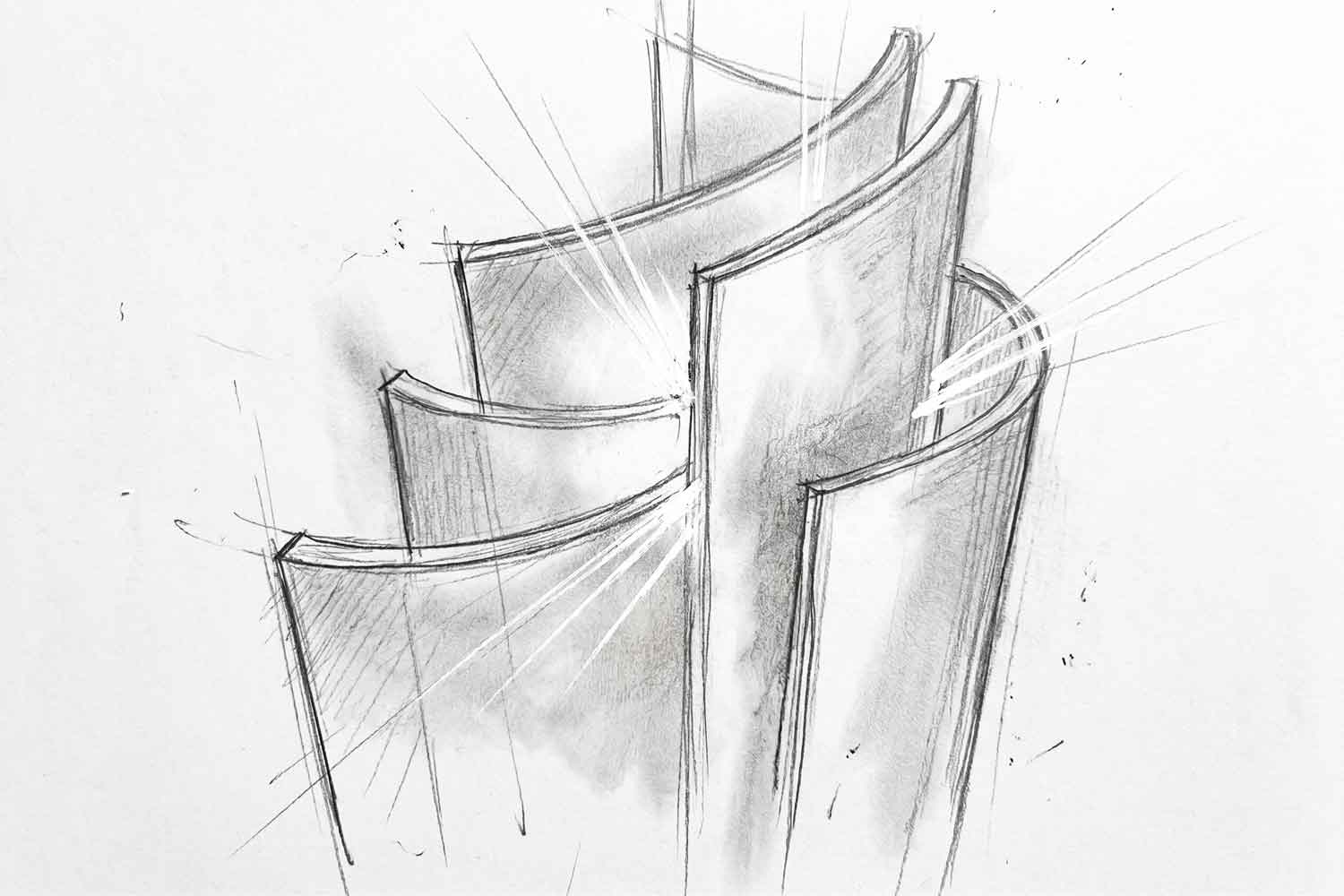
The panels are set in overlapping layers, stepping down toward the point, with a narrow space left between each one. When Duo Facies is lit, the bronze side holds the light back, and the light does what it has always done when something stands in its way. It finds the edges.
Thin rays slip out between the layers, the way the sun breaks around a mountain ridge in the last moment before it clears it.
Three Versions
One Idea, Told In Three Lights
Once the two faces existed, they asked to be seen at more than one hour. Choose a version, then drag across the chandelier to turn it on.

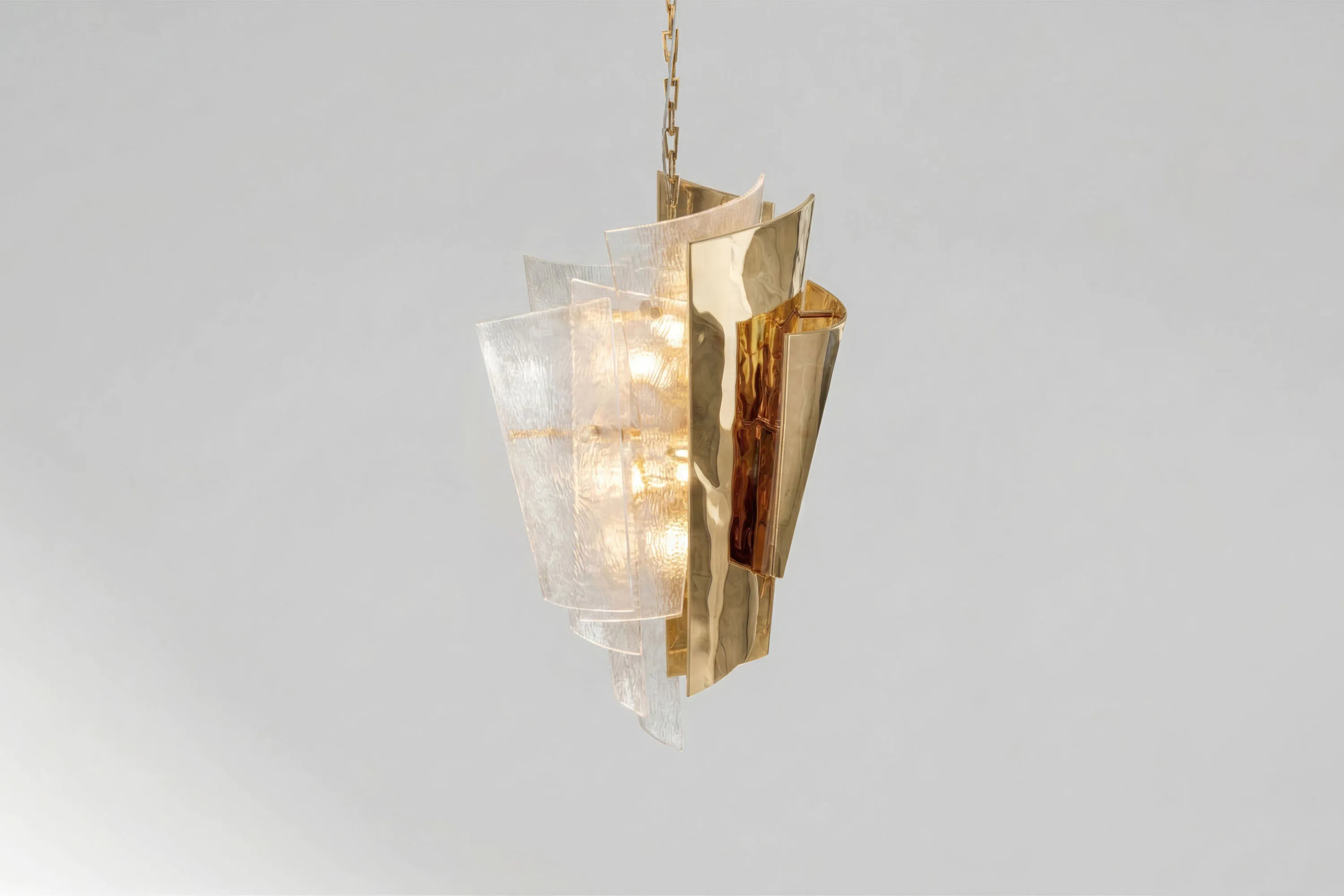

The first version. Mirror polished bronze beside textured Murano glass: warm gold against clear water, the moment the sun first touches the sea.
Polished stainless steel takes the place of bronze, and the glass turns to alabaster patterned Murano, clouded like stone. Silver beside soft white: the same conversation, held by moonlight.
Here both faces turn toward the light. Every panel is alabaster patterned Murano glass, so the chandelier glows evenly from every angle, for any space that wants light all the way around. It is the hour of noon, when no side is left in shadow.
Made By Hand
Two Faces, Two Crafts
Each face has its own craft. The metal panels are shaped by hand and polished until their surface holds a clean reflection. The glass is made in Murano, cast and then textured by hand, panel by panel. The two halves meet only at the end, when they are brought together on one frame and hung as a single piece.


Every dawn is a door left open between night and day.
Duo Facies keeps that door open, in bronze, in steel and in glass.
Choose Your Hour
Duo Facies is made to order in bronze and Murano glass, in steel and alabaster, or in pure alabaster, and each can be sized and finished for the space it will light. Tell us which hour you want to live with, and we will begin.